U.S. constitution-protected rights overview refresher for immigrant solidarity


This overview refresher is for people like me in the U.S. who haven't had to live knowing every detail of these rights every day– to save our lives and our families' lives daily– and so across our busy lives the fine details of our constitution-protected rights slip away from our easy-to-access memories. Knowing these rights is important now. Knowing them well enough that you can pull them up from memory, lean on them yourself, and also share them with vulnerable others clearly and calmly during immigration enforcement activities, sightings, and detentions is important. I believe that people who understand and share these rights with others are less like to make scary situations worse for the most vulnerable people present and may even make the person(s) feel a little better. The folks who need detailed knowledge of these rights just to survive every day in the U.S. teach whole classes on this subject. They're the experts, and they've been working collectively for generations to use these rights to protect the vulnerable in their own families and communities. The recent immigrant- and queer-led classes that I took across the past few weeks were remarkable and humbling, to say the least. I needed the refresh from those with the most experience. I'm so grateful for them and their work.
I'm taking classes and working my way up to join Washington Immigrant Solidarity Network's (WAISN) Accompaniment program. With immigration enforcement expanding into previously safe spaces such as courthouses, administrative offices, schools, churches, etc., this program pairs trusted, caring citizens with immigrant and refugee families who are following the rules and going to their scheduled Department of Homeland Security (DHS) appointments and hearings. The Accompaniment program I'm joining isn't legal support. It's free and gladly offered emotional support. Volunteer neighbor helping neighbor support. Community organizations helping all community members support. I could not love this idea– or the people making this happen– more. It's right up my care bear* alley, and even knowing the risks, there's nowhere else I'd rather be this year.
The process of joining WAISN's Accompaniment program appears to take a couple of months at the moment. I'm three weeks in. You have to take a few short online classes, fill out a volunteer agreement form that you receive after taking the classes, and pass a background check before you're assigned to a team. I'm in the middle of that now. It's all been online so far and remarkably caring, supportive, and convenient. These folks live their values at every step, and I offer an extra deep bow to the generation that so fluidly makes technology work for people of all ages, and several languages, wanting this important training now. Last week I took the 2+-hour Accompaniment program class: it felt welcoming, exciting, then overwhelming, and finally, grounding, empowering, and inspiring. This training was a gift– a direct, practical reminder of how much power we have as communities and caring, loving human beings. After 10+ years of focused elder caregiving for my parents here, on top of starting and running my own business and writing, for me, moving back into the world of community organizing felt like pure bliss by the end. We know our people when we feel them, don't we? No matter what languages we speak.
In the weeks prior, I first took their training to get to know WAISN better as an organization, then I signed up to be member, and I also took their wonderful Know Your Rights constitution-protected rights training. So that's what this post is: some reminders and key points from WAISN's Know Your Rights training, from my detailed notes. Most of which I already knew because I'm a lifelong neighbor-helper and volunteer, and long-time-ish (25 year) protestor, but at 55 I have a memory that's not 100% reliable anymore. Refreshers are grand! And I'd already been sharing Know Your Rights cards and leaning on the on the ACLU website for the past year, again, too. But the training is better than the cards. Far better. Because it comes with new community, detailed local wisdom, more ways to help, and you can get your questions answered. FYI, WAISN doesn't recommend the use of whistles that some other communities in the country are now using to announce the presence and detention activities of immigration enforcement. WAISN is laser focused on what the immigrants who live here, in Washington, themselves, most need and ask for, and what they don't want. Because they are recent or relatively recent immigrants to Washington themselves, they fluidly center who matters most and what matters most to them.
This post isn't legal advice. If you're in Washington state and want to get more involved in standing in solidarity with immigrants and refugees in the U.S., consider visiting waisn.org and taking some of their trainings, joining a team, and/or becoming a member and donating to their many worthwhile causes from policy change to deportation defense funds. If you can do all that, do all of that. Because what you learn and do with WAISN can help you keep everyone in the U.S. safer, including your own friends and neighbors and family– visitors, immigrants, refugees, and citizens alike. WAISN is an umbrella organization that supports and works with 400+ groups and community centers and organizations in the state that care about the rights and protection of immigrants and refugees. So if you volunteer with another immigrant solidarity organization or community center in Washington state, you may be sent to some of their training or be otherwise supported by WAISN.
Constitutional rights for all people in the U.S.– the rights you'll most likely need to lean on related to immigration enforcement and immigrant solidarity
These rights are guaranteed to all people in the U.S. regardless of who is present or the immigration status of the people present:
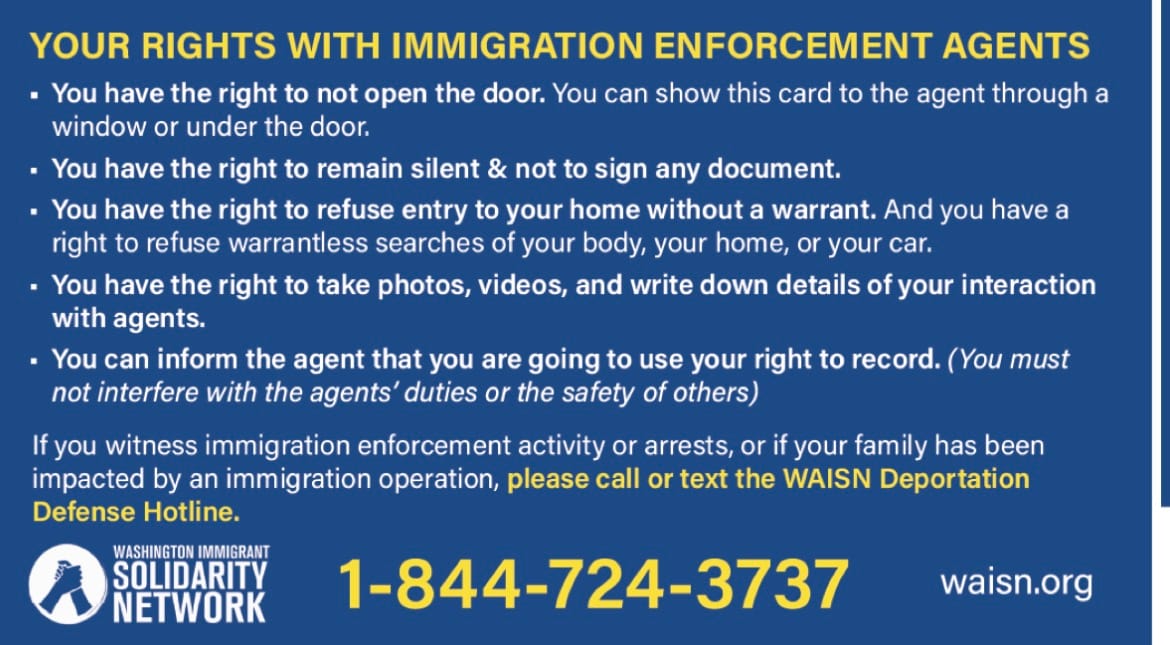
- Remaining silent. Everything you say can be used against you by officers. You have the right to stay silent. To not be forced to speak to or negotiate with people who have everything to gain by lying to you, intimidating you, and/or threatening you. Take some deep slow breaths in and out and channel your inner wise ancestor (that's the care bear* in me speaking), and don't give in to immigration agent pressure or fear tactics. You do have to say your name, if asked. WAISN says that it is best to communicate out loud something like: "I am exercising my right to stay silent." and then you don't have to open your mouth again to speak unless you want to ask for legal representation.
- Legal representation. If arrested by police, you have a right to an attorney provided by the government. If you are detained by immigration officers (ICE, border patrol, etc.), you have the right to hire and speak with an attorney at personal expense, but the government won't provide one for you. Say out loud something like: "I want to speak to an attorney." You have a right to a private phone call. Police aren't legally allowed to listen to calls with lawyers. You can also say: "I want to use my right to make a private phone call." From my own experience, I know that many immigrants and refugees in the U.S. often memorize the number of an immigration attorney in case they are detained and their phone is taken away from them. And I know that many people attending protests often write the number of an attorney somewhere on their body in case they are arrested for exercising their right to protest.
- Documents. You have the right to refuse to sign any documents. You don't have to sign documents you don't understand or don't understand all the short term and long-term implications of. You have don't have to sign documents if they're not in your preferred language. You don't have to sign documents without your legal representation present to advise and assist you. Don't present or carry false documents. Don't lie. Also, U.S. citizens don't have to carry proof of U.S. citizenship. If you have valid immigration documents and are over the age of 18, you do have to carry immigration documents with you. Your legal representation can help you understand what documents mean and make the best legal decisions for you and your family.
- Warrants:
- Judicial warrants: Judicial warrants are search warrants. They give immigration agents the right to conduct a specific search, of a specific person, at a specific location, and for a stated purpose. ICE cannot enter your home or private spaces within businesses and organizations without a judicial warrant signed by a judge. The judicial warrant must have all four of these things to be valid: 1) the correct name of the person they are seeking, 2) the correct address of the person they are seeking, 3) the warrant is signed by a judge (if it's not signed by a judge, they can't lawfully enter homes or private spaces or search your body, car, or private property), and 4) be from a U.S. district court. Agents might lie and say that they have the right to enter and search without a judicial warrant. That's not true. Legally, they can't enter and search private spaces without a judicial warrant. If they do have a judicial warrant that has all four items mentioned above, agents can legally come into the space even if you say no.
- Warrant for Removal from an immigration officer. ICE may call these "warrants," but immigration lawyers say they're not warrants. They direct an immigration officer to arrest a specific someone. They do NOT grant permission for an agent to enter your home, but they can look for you in public places. It is not a search or seizure warrant. It will say 1) Warrant of Removal/Deportation, 2) be from ICE, and 3) have a signature of an ICE officer, but not a judge. It must have the correct name and a signature from an immigration officer. They can arrest people in public places such as parking lots, sidewalks, and outside of your home. They might lie and say that they have the right to come into your home with just this document. They legally can't. You don't need to let them in to private spaces. What to do:
- At home. Don't open the door/window. Ask them to show their ID and badge through a window or peep hole. Say that you don't speak English if you don't. Ask for a Judicial Warrant. Make them show you a signed Judicial Warrant (with all elements mentioned in a. above) through a window or peephole. Only a Judicial Warrant can compel you to open your door. If possible, have someone record everything that happens. If they don't have a judicial warrant, you don't have to open your door and they cannot legally enter.
- In a car. Stop in a safe place as soon as possible. Turn off the car, turn on an interior light so they (and any cameras watching) can see your hands, and crack the driver's window open just slightly. Refuse a search unless they have a Judicial Warrant signed by a judge. They can request the driver's driver's license– slip it through the slightly opened window. These days, sadly, ICE is demonstrating a willingness to break the law and become violent: they've been documented shattering car windows, hitting and dragging people out of vehicles, stopping people based on the color of their skin or accents, taking people without warrants, shooting tear gas into and near vehicles, shooting and killing people in their vehicles, running over people with their own vehicles, and leaving children behind without parents, even in freezing cold weather. Because we are allowed to record and document, they are recorded breaking the law regularly now. We don't get to. So don't use or show fake documents. Remember that you have the right to remain silent, not answer their questions, and ask for an attorney. If you're the driver of the car, stay focused on the traffic stop itself. Why were you stopped? And if you weren't doing anything wrong and they don't have a judicial warrant, are you being detained or are you now free to go? Passengers don't need to answer questions. Local police should not be doing the job of federal immigration enforcement per the Keep WA Working Act (KWW) in Washington state. We all have the right to remain silent. But as a citizen and the driver, you can say out loud to immigration officers: "You have no jurisdiction over me as a U.S. citizen. I am the driver of this vehicle. Without a Judicial Warrant, you don't have the authority to enter this vehicle." or just "Without a Judicial Warrant, you don't have the authority to enter this vehicle." Without a Judicial Warrant, immigration officers don't have the legal authority to enter and search a vehicle. If they do, they are breaking the law.
- Right to record and document. You have the right to record and document what's happening during immigration activities, sightings, and detentions, including in public places, as long as you don't interfere. Record what's happening. Don't interfere. You can take photos, videos, and take notes about what's happening. Say out loud "I'm exercising my right to document and record." Personally, if I was told to step back by an immigration officer, I would step back while still recording and calmly say out loud: "I am not interfering. I am also stepping back as you requested. I'm exercising my constitutional right to document and record." so it's on the record that I was clear, calm, not interfering to begin with, aware of my rights, and complying with instructions to step back.
A bit more about WAISN, their Rapid Response Team training, and their hotline
WAISN offers advocacy and policy work supporting the rights, dignity, and power of immigrants and refugees in Washington state, plus deportation defense, and grantmaking and funding development. They also train and deploy Rapid Response teams. I haven't taken it yet but based on my experience with all their classes that I have taken, I can already recommend their Rapid Response Team training. Rapid Response teams are local volunteers and community organizations that show up to support families, witness, record and document what's happening, and remind people of their rights when ICE is present. As an organization, WAISN has been training Rapid Response teams since 2018, although it's clear that they lean on cross-generational and cross-cultural knowledge and traditions far older than that.
The only reason I didn't take their Rapid Response Team training first is that I live on an island, and, at present, most ICE activity seems to be on the mainland. With a ferry wait and ferry ride between me and the most likely impacted schools, homes, churches, businesses, and neighborhoods, I fear my response wouldn't be nearly as rapid as needed for a Rapid Response team. Their Accompaniment program– going with people to scheduled appointments– means that I can plan ahead and get to people when they need me, not potentially showing up too late in an emergency situation. But I intend to take the Rapid Response team training soon, too. The more classes I take, the more useful I'm likely to be to all neighbors.
Hotline
WAISN also offers a hotline for all people impacted by immigration enforcement activities, sightings, and detentions. The hotline is 1-844-724-3737. You can call it Monday through Friday, 6 am to 6 pm, and text it after hours. They will want to know details such as who you saw, what (what happened or is happening/what were they doing/what were they wearing/driving), when, and where, so they can write up a report and make decisions about what to do and send Rapid Response teams if needed.
*If you don't know what a human care bear is, picture medic tents at huge events or protests– a place where hurt, exhausted, over-heated, or tear-gassed people can come for on-the-spot medic-type treatment for the body. Now, picture sensitive folks, empaths, kind parents/grandparents/caregiver type folks, gentle community leaders, mental health helpers, and/or herbalists carrying plant friends all working to emotionally support other people, neighbors, and protestors. People carrying and handing out water to others, offering kindness in a variety of forms, holding the hands of people who need someone to lean on, crying with folks who need to cry, and sometimes working near or alongside the medics– people who help with the emotional impacts and damage caused by being demeaned, abused, physically assaulted, gassed, not seen as human beings, witnessing cruelty and violence toward others, and otherwise attacked by representatives of this country and government for simply living, protecting your neighbors, or exercising your rights, including the right to protest. Some care bears may also have formal de-escalation training as well, although de-escalation is often a more specific role at protests: people present who were trained to specifically look for and de-escalate potentially violent situations. So, anyway, that's care bears. We rock! Just very gently. ;-)