Friendship teas & ceremony for those feeling heartbroken right now

This post is for anyone feeling heartbroken right now, for any reason.
The Blessing: May we speak the heartbreak of now together
May we allow the speaking of our heartbreak to be our offering to the world now. When we're so heartbroken that we feel stagnant, stuck, tight, sore, worried, depressed, unable to motivate or move, scared, lost, alone, like hiding, chronically angry, and/or exhausted by anything or everything, including blame, may we call forth the generous gift of speaking our heartbreak to each other. Face to face. Voice to voice. The teas here help turn the speaking of our heartbreak into simple ceremony— to stay with and honor what we're feeling and to celebrate friendship, simultaneously. The plants and the land where they're from are our friends, too. Old friends. Friends to each other and friends of our ancestors. Together we recognize ourselves and our friends as an integral part of the magic and medicine that we and our world have to offer and need.
A new old way
If trying to motivate yourself to do something new, difficult, scary, or generous when you're also heartbroken has been your default way of being for a while, consider this way instead. If you want to try this friendship tea ceremony but you don't have the energy, send a link to this post to a friend or neighbor who has more energy than you– or someone who you create energy with when you're together– and ask them if they'll help you gather some ingredients and make and drink some friendship tea together. Asking for help, being open to receiving help, making things together, sitting face to face, working with our hands side by side, noticing each other's strengths and needs, and more regularly remembering that we're actually powerful collective beings who belong here and contribute to the magic and medicine simply by being here together– these are some of the gifts that people like us (me and my people, at least) are here to remember and learn for good this time.
Two friendship teas I made for a friend in the heart of winter, and the friendship tea ceremony
I made these two friendship teas two weeks ago for a long-time friend. They were feeling isolated, down, anxious, and they were wanting to feel calmer as they more fully faced the violence-centered reality in the U.S. I live on an island 2 hours away from them, with an expensive ferry ride and drive to get there, or I would have shown up in person, with the ingredients, and we would have made and shared these teas together. As it was, since my partner goes over there to teach, I had him deliver the teas to them– they're friends too– and I asked that they drink the first cup of them together, which they did. Thought I'd share the recipes here this week. And add the ceremony I use when making and drinking friendship tea with friends.
You don't gather and make friendship teas for yourself, by yourself. You make friendship teas for a friend(s), or even better, make them together with a friend(s), and you drink them together, with friends. At least the first cup. And then you talk, laugh, and cry together, like earthlings who value their home and each other. If you make a large batch, ideally drink a least one cup together, at least one time, first: before you drink any alone. Making and/or drinking these teas together infuses them with your own friendship magic. The rest of that jar/gift is pure gold. The sooner more folks realize that we are part of the living medicine/belonging/solution/heart of the world and not small, helpless individuals floating alone in space, the better, from my perspective. And, you do you. You don't need to believe what I believe to be part of the medicine/belonging/solution/heart. But you do need friends. We all do.
Recipe & ceremony 1: Daytime friendship tea for the brokenhearted in the heart of winter & empire
In the morning or daytime:
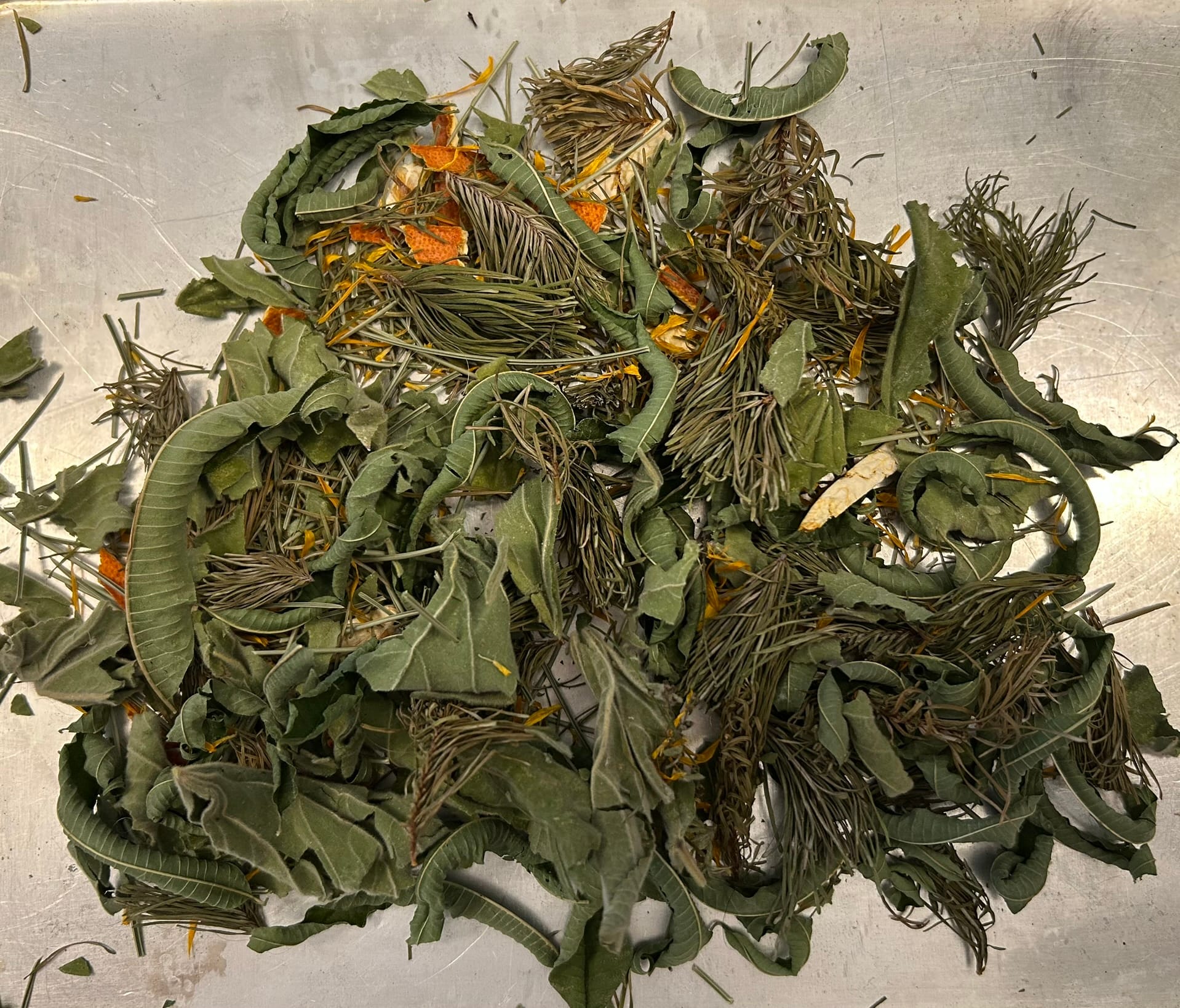
- With a friend or for a friend, intuitively gather and mix together roughly equal parts dried or fresh:
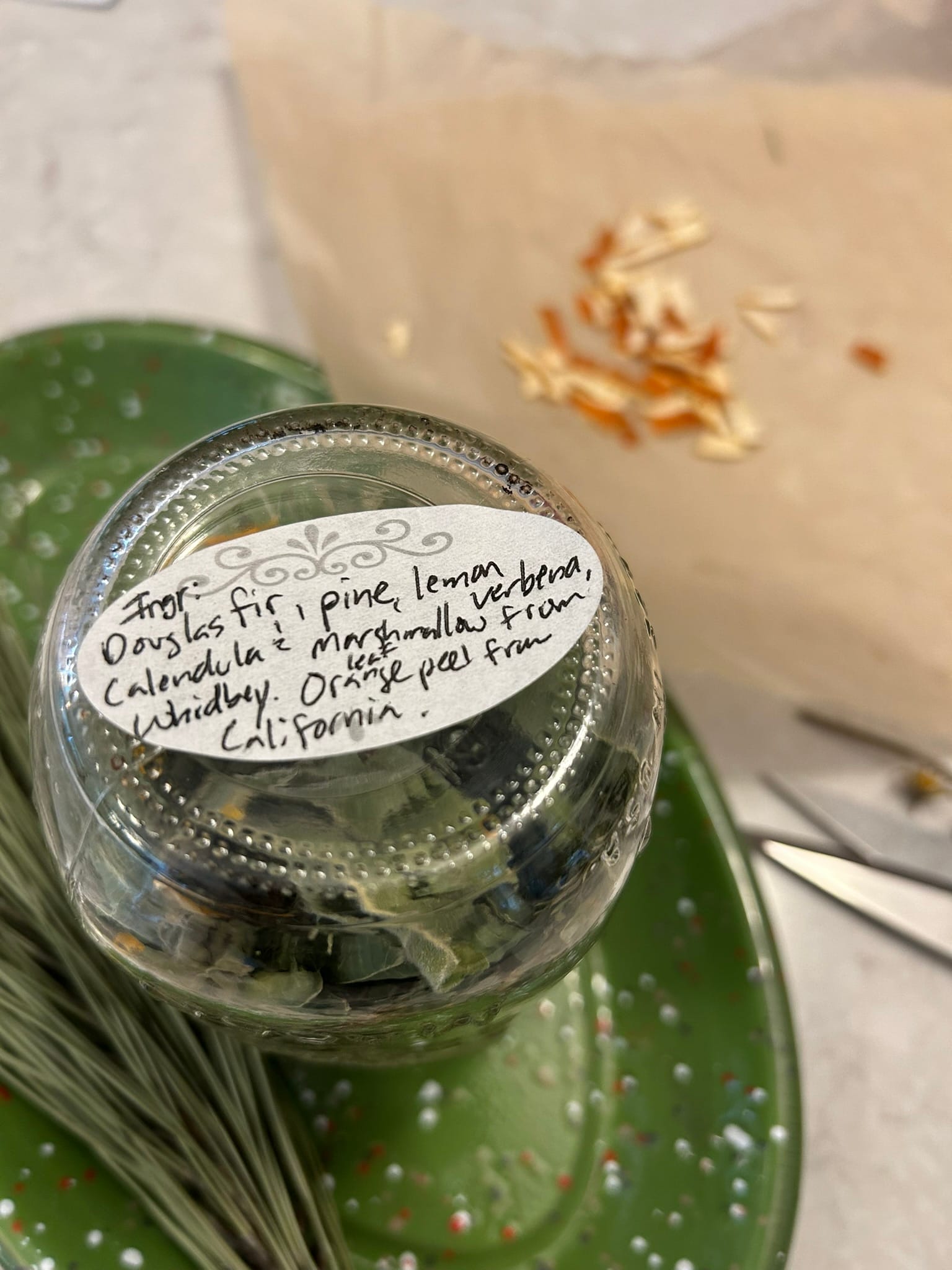
- Lemon verbena leaves (chosen here for their remarkable flavor and tendency to foster a sense of joy and peace and their ability to help people get more present, want to stay longer, have another cup of tea, and stay present long enough to deepen understanding)
- Douglas fir tips or needles (chosen here for their steadfast wisdom and humor and generosity here and their ability to help people relax by helping us unwind our worrying, spinning minds so we can feel like we belong again)
- Pine needles (chosen here for their gentle, open, and glorious nature in general and their fragrance, warming tendency in winter, and ability to improve my mood)
- Marshmallow leaves (chosen here for their ability to help us feel more fluid and less rigid and support for remembering your ability to be more flexible together and more go-with-the-flow as friends)
- plus a few pinches of: Dried orange peel and Calendula flower petals (chosen here for their collective beauty medicine, ability to create movement in the circulatory and lymph systems, remove stagnation from the body and gently/steadily invigorate mind and body, re-connect you to needed sunshine, and soothe digestive inflammation– I also chose the orange peel because my friend is originally from a sunny place and struggles with our much grayer Pacific Northwest winters). Two notes. Note 1: don't take calendula internally if you're pregnant unless cleared by your herbalist or other trusted heathcare guides and professionals, and if you're allergic to ragweed then you may want to pass on calendula flowers too, but a few are usually fine for most). Note 2: I chose this combination of plants for a specific friend. If you are friends with other plants and you want to change something to make sure you and your friend(s) will enjoy it even more, you can choose other plants. However, if you're not good friends with a plant– good enough to know its history with humanity or at least its history with you and the friend you're making it for–go carefully. Plants are powerful beings. Some interfere with medications, cause allergic or intense reactions, etc. We're here to mend our broken hearts and celebrate friendship together, not put anyone in the hospital. ;-) - When they're mixed together, figure about one tablespoon of tea mixture per cup or mug. A little more if you're using chopped fresh plants. If you want to figure out the weight of the amounts of tea per cup/mug that you like best, you do you. My dad would. But that's not me. Each time, I/who I'm with co-create what I/we believe each friendship and unique person and moment needs or would like. If you're using dried plants and making a jar as a gift or for later use, keep the plant parts in as large a form as possible in the jar (whole leaves, whole tips, whole or halved needles), and then crush the plants together just before you make the tea. Some (like lemon verbena) will crush well. Many of these other plants don't. Just do your best and focus on the friendship and creativity parts, not the striving-for-perfection part. This is not that kind of tea. This tea and ceremony support relaxation (especially relaxing worrying, spinning minds), collective creativity, trusting yourself and others more, and deepening relationships with friends, plants, and the planet we live on.
- Invite your friend over if they're not already there helping or take the tea ingredients to their house.
- Together, using whatever tea-making devices you have, steep the ingredients in hot (between 185 and 200 degrees or just before boiling) water for 5-10 minutes, covered, and then remove the plants from the tea. If you want to do a longer medicinal infusion (like 1 to 6 hours), you can do that with some of these plants. Use boiling water to do that and keep it covered once boiled. Just keep the lemon verbena, calendula petals, and orange peel out and add them at the final 5-10 minute mark, or when the infusion still has a little heat left, or when you briefly reheat the infusion after it has cooled. I've noticed that– like walks in the woods– long-steeped pine and fir together give our family more energy, especially for things we want to do. The calendula petals can also be added last and left in the tea to drink as extra beauty medicine. The orange peel can be too if you like chewing on softened orange peels. Use the longer steep time to catch up as friends or do something fun together. If you do more than a 2-hour infusion, when you remove the plant material, you'll likely need to rewarm it in a pan on the stove or however you warm tea.
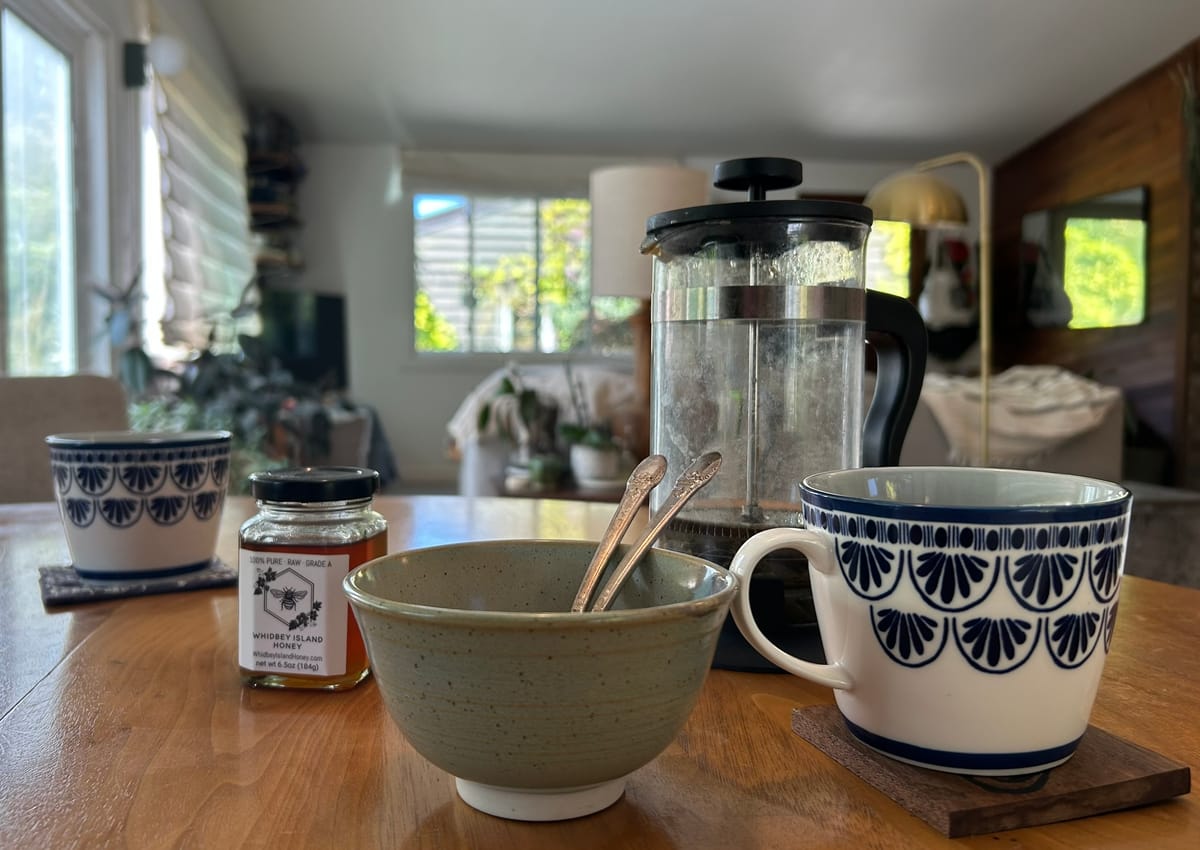
- Pour the tea into teacups or mugs. Slowly stir in honey or sweetener of your choice and then milk or milk alternative, to your taste. If you like really hot tea, heat the milk/milk alternative before adding.
- Gently touch your cups/mugs together and honor friendship in some way with your voices before you drink. Such as saying, "To us!" or "To friendship!" or "I'm so grateful for you!" or "Friends forever!" These are just initial examples. What you say should reflect who you are as friends. For example, if you are regularly silly together or corny or weird or fierce or cringe together or regularly cry together or protest together or have a name for yourselves as a group– that is part of the friendship medicine. Honor the friendship. Inside jokes– unique to your relationship– are a wonderful thing to say out loud before you drink friendship tea.
- Honor those not present, if needed. This step is optional for some and culturally necessary for others. If you have lost someone or you are missing someone (like a third friend who can't be with you), another variation of the ceremony is to pick up and then briefly touch/clink your cups to the table first, saying "To those who can't be with us." before clinking your cups together to honor your friendship and those present. If you do this step, it should come before step 6. I put it here because not everyone will do this step. It's optional.
- Have a long conversation as you drink the tea. This is the time to speak about what's breaking your hearts and the time to really listen to each other. Skimping on this time together is a very bad idea. Do that long enough and you could find yourself living in an off-the-charts violent country that attacks its own people and neighbors out of delusional fear and where people are too isolated, exhausted, defeated, or scared to speak up and make change. Most adults can drink 2 or 3 cups of this tea without issue. Take your time.
- When you're done, wash the dishes together before you part. There is magic in this step. Try it or return to it if you've let the practice go.
Many of my herbalist teachers believe that local land and local plants know us best and serve us best. As we do them when we're paying attention. I've come to believe this too. So, when possible, gather abundant local plants out of your own garden, from your neighbors, local farmers markets, community gardens, or foraging from neighboring lands that you or your friends love and tend. Use local milk or milk alternative when possible. Use local honey or other sweeteners when possible. Local is important. And... local is not always possible here in the heart of winter and empire. So, the most important words in this paragraph are "when possible." Don't worry AT ALL if you can't find local plants or make local milk or honey happen right now. All in good time. Many plants are out of season in winter. Access to land and local plants is impossible for so many now. Local, in-person friendship will suffice even with random Grocery Outlet tea bags. We– you and I– are part of the medicine/belonging/solution/heart of the world. We are enough. Really.
Recipe & ceremony 2: Nighttime friendship tea for the brokenhearted in the heart of winter & empire
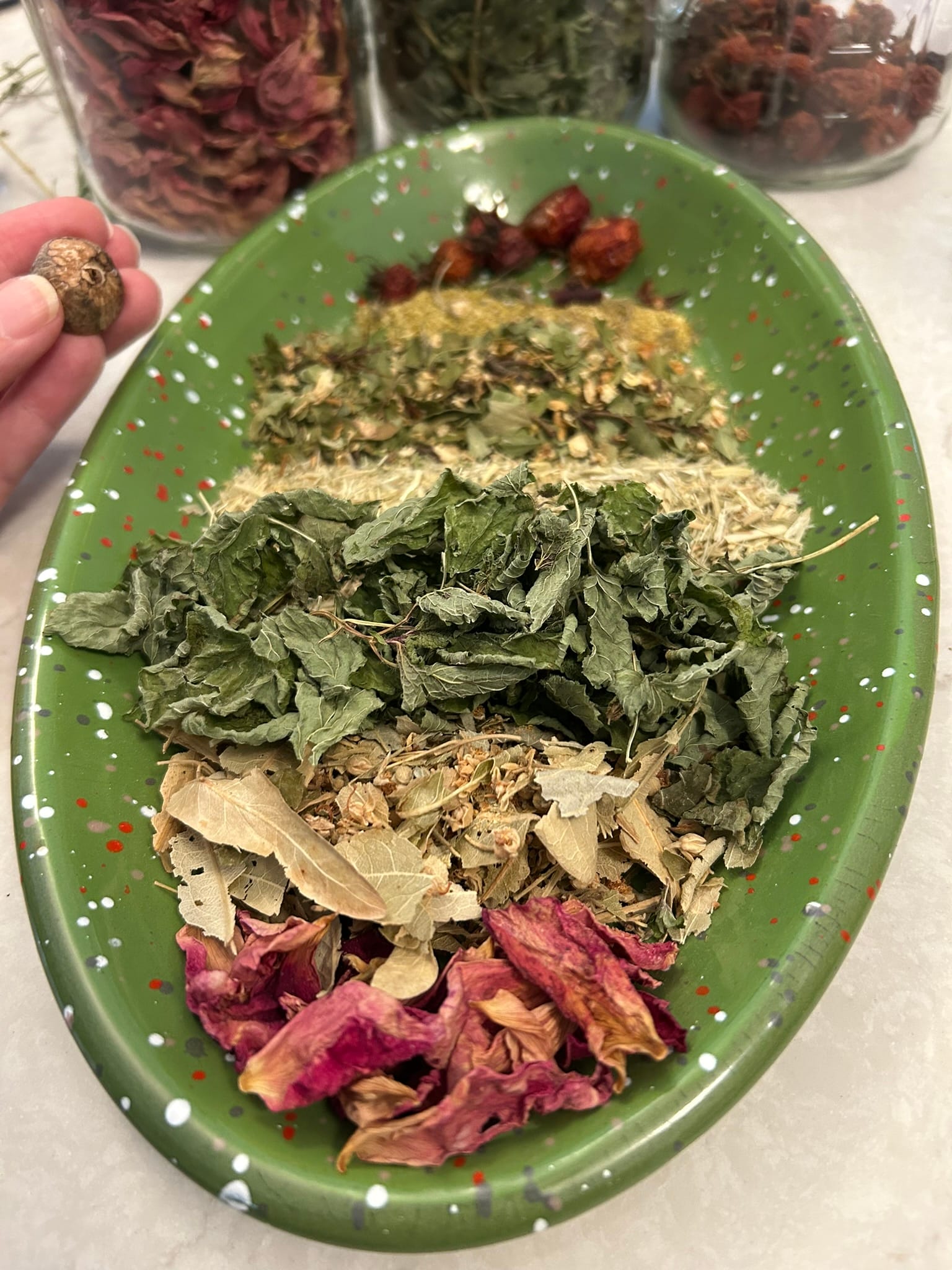
This is a more relax-together-and-prepare-to-rest-centered blend.
In the evening, 1 to 3 hours before you plan to go to sleep (or longer if you do a long-steeping infusion*):
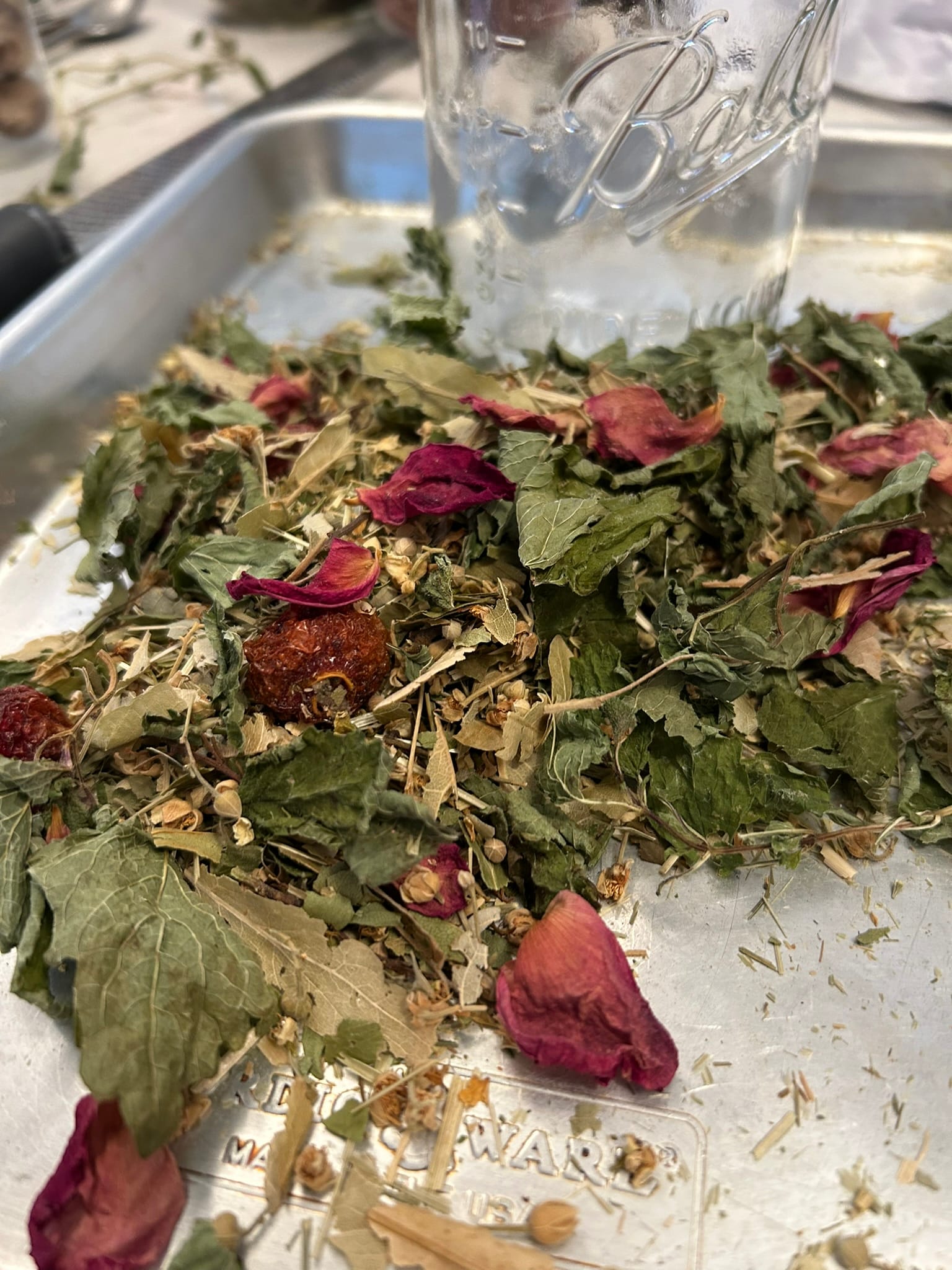
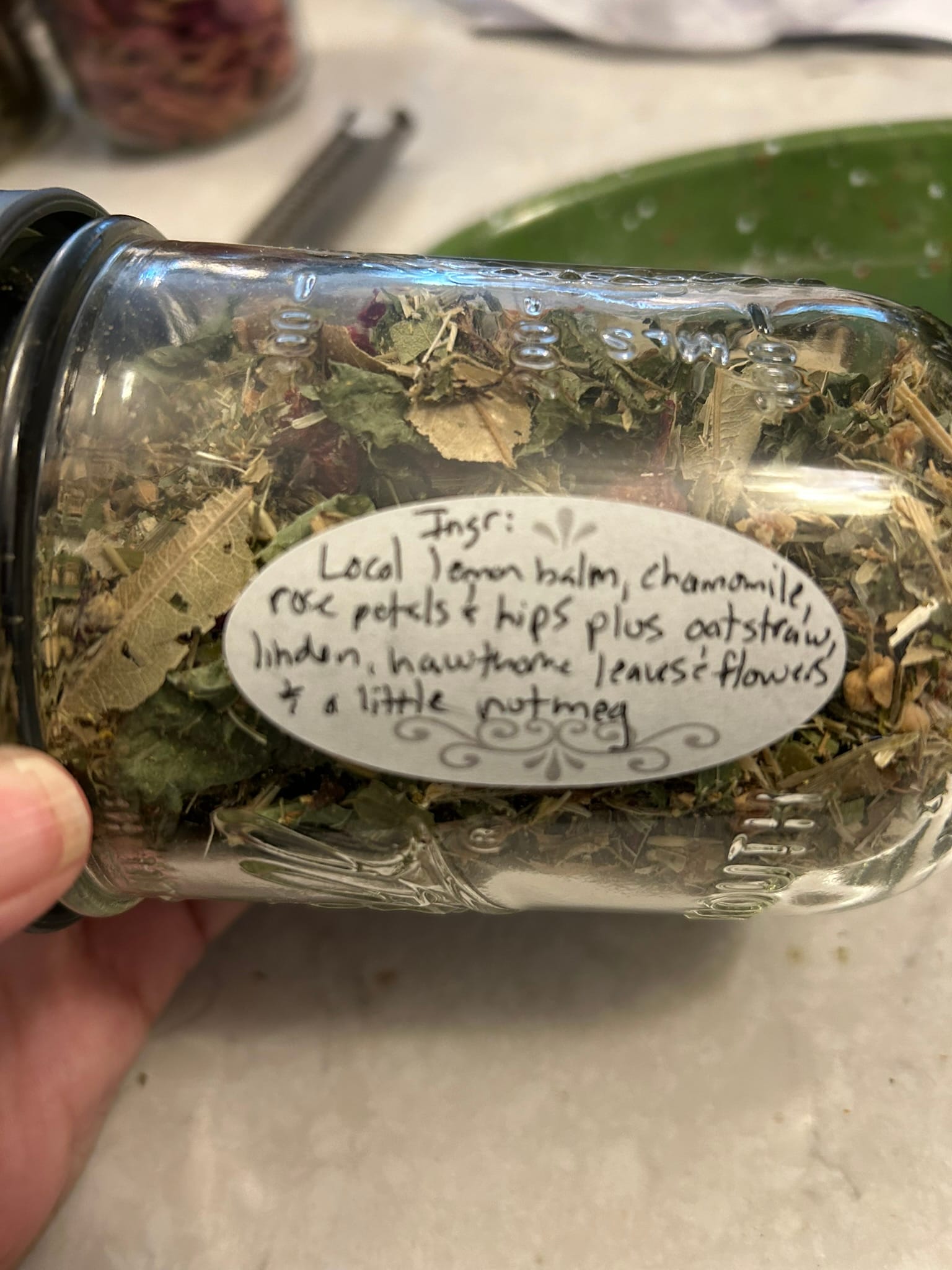
- With a human friend or for a friend, intuitively gather and mix together roughly equal parts by weight of these plant friends:
- Lemon balm (chosen here for its ability to gently relieve tension throughout the body, relieve nervousness, soothe a nervous stomach/digestive upset or nervous heart and help with difficulty sleeping, especially good for nervous exhaustion)
- Chamomile (chosen here for its flavor and because it is gently relaxing without being too sedative, good for moments that set you on edge and when you feel your body stiffen, useful anxiety support, eases restlessness, and invites sleep**) (use just a tiny bit or leave this out entirely if anyone is allergic to ragweed)
- Wild or garden or purchased from a reputable herb seller (like Mountain Rose Herbs) rose petals and hips (chosen here for their emotional heart opening nature, supportive of feeling compassion and love and also boundary setting in relationships, for some there's a connecting with ancestors from the land you're on, and especially good for when your emotional heart feels attacked, tender, and hurting plus they taste great). I like using petals and hips together but petals alone are more than enough if that's what you have. Note: For most, rose is a powerful friend of the brokenhearted. If you're living with a chronic broken heart, it's not a bad idea to talk to local herbalists/clinical herbalists/naturopaths/doctors/other healers who know about plants about connecting more deeply or more often with rose).
- Oatstraw (chosen for its ability to relax the nervous system, help us feel juicier/sassier, and help us connect with the familiar in new ways). Oatstraw is the whole (above ground parts) plant. Milky oats work too if that's what you have but I'm one of those old-school herbalists who prefers oatstraw.
- Linden (chosen here for its delightful sweet, tropical flower-type flavor and ability to safely calm and relax us, its mild sedative effects, and because it supports and offers some relief to those feeling significant stress and/or anxiety)
- Hawthorn leaf & flower (chosen here because of its affinity for the emotional heart and helping us feel emotionally balanced, relaxed, less anxious, and hopeful, and also because I've noticed hawthorn helps us talk about boundaries and set much-needed boundaries so we can heal from hurt without spreading more hurt around.) Note: For most, hawthorn is remarkably good for our cardiovascular systems in general. If you're living with a chronic broken heart, it's not a bad idea to talk to local herbalists/clinical herbalists/naturopaths/doctors/other healers who know about plants about connecting more deeply or often with hawthorn.
- Plus just a small dash/sprinkle of dried nutmeg. (chosen here for its warming, relaxing, mood lightening, sleep-promoting, and tasty nature– just don't do too much! Just one a small dash/sprinkle from the jar or one scrape down the microplaner if you have whole nutmeg. In my experience, more is definitely not better.) - When they're mixed together, figure about one tablespoon of tea mixture per cup. A little more if you're using chopped fresh plants. If you want to figure out the weight of the amounts of tea per cup that you like best, you do you. That's not me. If you're using all dried plants and making a jar as a gift or for later use, keep the plant parts in as large a form as possible in the jar (whole leaves, whole flowers, etc.), and then crush the plants together just before you make the tea. Except for the nutmeg, which you should add just a small dash of at the end. Some (like lemon balm, chamomile, linden, and hawthorne leaf) usually crush well when dry. Some of the plants/parts don't. Just do your best and focus on the friendship and creativity parts, not the striving-for-perfection part. This is not that kind of tea. This tea and ceremony support relaxation, rest, collective creativity with friends and ancestors, and deepening relationships with friends, plants, and the planet we live on.
- Invite your friend over if they're not already there helping or take the tea ingredients to their house.
- Using whatever tea-making devices you have, steep the ingredients in very hot (between 185 and 200 degrees) water for 5-10 minutes*, covered, and then remove the plants from the water.
- Pour the tea into teacups or mugs. Slowly stir in honey or sweetener of your choice and then milk or milk alternative, to your taste. If you like really hot tea, heat the milk/milk alternative before adding. If you like nutmeg, you can add one more dash of nutmeg to the top of each drink just before drinking.
- Gently touch your cups/mugs together and honor friendship in some way with your voices before you drink. Such as saying, "To us!" or "To friendship!" or "I'm so grateful for you!" or "Friends forever!" These are just initial examples. What you say should reflect who you are as friends. For example, if you are regularly silly together or corny or weird or fierce or cringe together or regularly cry together or protest together or have a name for yourselves as a group– that is part of the friendship medicine. Honor the friendship. Inside jokes– unique to your relationship– are a wonderful thing to say out loud before you drink friendship tea.
- Honor those not present, if needed. This step is optional for some and culturally necessary for others. If you have lost someone or you are missing someone (like a third friend who can't be with you), another variation of the ceremony is to pick up and then briefly touch/clink your cups to the table first, saying "To those who can't be with us." before clinking your cups together to honor your friendship and those present. If you decide to do this step, it should come before step 6. I put it here because not everyone will do this step. It's optional.
- Have a long conversation as you drink the tea you made. This is the time to speak about what's breaking your hearts and the time to really listen to each other. Skimping on this time together is a very bad idea. Do that long enough and you could find yourself living in an off-the-charts violent country that attacks its own people and neighbors out of delusional fear and where people are too isolated, exhausted, defeated, stunned, or scared to speak up and make change. Most adults can drink 2 or 3 cups of this tea without issue, but if it's really close to bedtime, don't overdo it, just drink your cup more slowly. Take your time.
- When you're done, wash the dishes together before you part. There is magic in this step. Try it or return to it if you've let the practice go.
Again, many of my herbalist teachers believe that local land and local plants know us best and serve us best. As we do them when we're paying attention. I've come to believe this too. So, when possible, gather abundant local plants out of your own garden, from your neighbors, local farmers markets, community gardens, or foraging from neighboring lands that you or your friends love and tend. Use local milk or milk alternative when possible. Use local honey or other sweeteners when possible. Local is important. And... local is not always possible here in the heart of winter and empire. So, the most important words in this paragraph are "when possible." Don't worry AT ALL if you can't find local plants or make local milk or honey happen right now. All in good time. Many plants are out of season in winter. Access to land and local plants is impossible for so many now. Local, in-person friendship will suffice even with random Grocery Outlet tea bags. We– you and I– are part of the medicine/belonging/solution/heart of the world. We are enough. Really, really.
* Important: If you want to do a longer infusion (like 1 to 8 hours), you can do that with some of the more nutritive plants: oatstraw, linden, rose hips, hawthorne. Use boiling water and then keep covered. Just keep the lemon balm, chamomile, rose petals, and nutmeg out of the long-steeping infusion. Add the lemon balm, chamomile, and rose petals when you rewarm the infusion and steep for 5-10 minutes. Add a dash of nutmeg at the very end. A couple of rose petals can also be added last into the cups and left in the tea to drink as extra beauty medicine. Use the longer steep time to catch up or do something fun together. If you do more than a 1-hour infusion, when you remove the plant material, you'll likely need to rewarm it in a pan on the stove or however you warm tea. The most important thing to remember if you're going to steep these plants for longer times, is that you should know these plants really well, know yourself and your friend(s) really well, and understand the impact of infusions on you and any medications you're taking, allergies or chronic conditions you have, or impact to those who are pregnant or breastfeeding. For example, long-steeped hawthorne infusions are used by people with high blood pressure to lower blood pressure, so if you or your friend have low blood pressure already, then doing a 4- to 8-hour steep of hawthorne may not be the best idea. Talk to a medical professional when any of you have concerns, allergies or chronic conditions, are taking medications, are pregnant or breastfeeding, or just have concerns about plant interactions. Clinical herbalists and many naturopaths are great at this, and medical doctors and nurse practitioners are catching up but– at least where we live– most now at least have access to databases that can help them advise you, especially about plant-medication interactions.
** Chamomile can help most people fall asleep. Some people will need another plant, such as valerian or hops. Chamomile is gentle for all ages. It is also in the same family as ragweed, so a few people with ragweed allergies do avoid it. If you don't already know, make sure your friend is ok with it before adding it to a blend.